Monday, January 23, 2006

Geo-caching/ The Russian spy rock

bbc.co.uk
UK diplomats in Moscow spying row
Last Updated: Monday, 23 January 2006, 10:14 GMT


[photo: Russian TV image of imitation rock; caption, "Russian TV showed what it said was the spy rock"]

Russia's state security service, the FSB, has accused British diplomats of spying in Moscow.

It backed claims made in a Russian TV report which showed footage of what it said was British agents retrieving data from a fake rock planted on a street.

The programme also said a UK diplomat made regular payments to Russian non-governmental organisations.

The UK Foreign Office said it was "concerned and surprised" and denied any improper conduct with Russian NGOs.

Reuters news agency quoted an unnamed FSB spokesman as saying that "everything that was shown [in the programme] was true and based on our information".


(We reject any allegation of improper conduct in our dealing with Russian NGOs- UK Foreign Office)

The programme said four officials from the UK embassy and one Russian citizen, allegedly recruited by the British secret service, downloaded classified data from a transmitter in the rock onto palm-top computers.

According to the programme, the Russian citizen was later arrested.

Hidden camera footage appears to show individuals walking up to the rock.

One man is caught on camera carrying it away.

The programme contained a number of interviews with people claiming to be Russian intelligence officers, who made the allegations.

An unnamed FSB spokesman told AFP news agency one of the accused diplomats was a 30-year-old archivist.

A FSB officer told Rossiya television the hi-tech stone was "absolutely new spy technology".

Claim denied

The UK embassy in Moscow has refused to comment, but the UK Foreign Office in London issued a statement.

"We are concerned and surprised at these allegations. We reject any allegation of improper conduct in our dealing with Russian NGOs," it said.

The Foreign Office said it was well known that the UK government had given financial support to projects implemented by Russian NGOs in the field of human rights and civil society.

"All our assistance is given openly and aims to support the development of a healthy civil society in Russia," the statement said.

Michael Evans, defence editor of the UK Times newspaper, told the BBC Russia is still regarded as a centre of espionage.

"People will be a little bit surprised at the bizarre nature of this episode. I've no idea whether its true but clearly there is a lot of intelligence gathering that goes on."

Source here

Sunday, January 22, 2006

Nintendo Wi-Fi Connection


1 UK Wi-Fi Connection partnership announced
Oct. 5, 2005


There is a revolution afoot in the worlds of Wi-Fi and gaming. Nintendo UK is bringing Wi-Fi technology into play from 25th November 2005 with a new groundbreaking deal with wireless providers BT Openzone and The Cloud. The launch of the Nintendo Wi-Fi Connection service means the UK will take an unprecedented step forward into a new era of gaming, allowing anyone to play against friends and family across the globe simply, safely and best of all - for free*.

To ensure that anyone really can play against others from all over the world with their Nintendo DS, the Nintendo Wi-Fi Connection can be accessed in any one of three ways:

1. Gamers will be able to visit any one of over 7,500 Wi-Fi hotspots at locations across the UK. These include McDonalds restaurants, Coffee Republic coffee houses, Hilton and Ramada Jarvis hotels, Road Chef and Welcome Break service stations, First Great Western railway stations, over 25 student unions and city centre BT Payphones and airports, football stadiums and even the British Library and Canary Wharf. By logging onto www.thecloud.net or www.btopenzone.com and entering your town or postcode; you can find the Nintendo Wi-Fi Connection hotspots closest to you.
2. Nintendo UK will also be installing BT Openzone Wi-Fi hotspots into major video games retailers and other key outlets across the UK, meaning it really is possible to game anywhere!
3. Gamers with a broadband internet connection at home will be able to enjoy the free*, simple and safe Wi-Fi gaming service; you simply need a Wi-Fi access point or hotspot, like a Wi-Fi wireless router, and an active broadband internet connection. If you do not have a wireless access point, you can purchase a Nintendo Wi-Fi USB Connector (available 25th November for around £30) which plugs into a PC and automatically sets up a connection for you.

Nintendo's Wi-Fi gaming service is free* - there are no fees or subscriptions to pay. It’s incredibly easy to use - you simply turn it on and select Wi-Fi, there are no complicated menu screens and minimum configurations required and most importantly Nintendo’s Wi-Fi Connection service is a safe environment for players. Players have the option to select to play with just friends, or people of a similar skill level around the world without fear of harassment. Players do not have direct communication with each other when playing anonymously and therefore personal details or inappropriate comments cannot be exchanged.

The launch of Nintendo Wi-Fi coincides with the return of infamous Nintendo title Mario Kart DS. Mario Kart is the first in what looks set to be a long line of titles to fully benefit from the Nintendo Wi-Fi offering. Also launching for the Nintendo Wi-Fi Connection on 18th November, and designed to take full advantage of the Nintendo Wi-Fi Connection, is Tony Hawk's American SK8Land from Activision; the first 3D Tony Hawk game experience for a Nintendo handheld system.

* Usual broadband line rental costs apply when accessing the Nintendo Wi-Fi Connection at home.

Source here

2
Here's the online "Find Hotspots"(- results for Cardiff)

For example The Old Library (pub):


CardiffCC The Old Library
Driving Directions
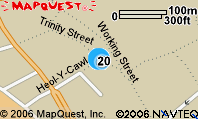
Trinity Street
Cardiff, CF10 1BH
Powered by:BT Openzone


3 More results: Caerphilly here


4 To be awkward,

I searched for Llanhennock (rural pub): the results here
reveal 3 pubs in Caerleon. Of course the Wheatsheaf pub in LLanhennock is a free house specialising in real ales- a lights-flashing ITBOX would just look sooo out of place (not to mention its size).


5 The Cloud

  • The Cloud homepage here

  • Wi-FI - How to Connect here

bbc.co.uk
City-wide wi-fi rolls out in UK
Last Updated: Tuesday, 3 January 2006, 14:52 GMT


[Woman using laptop in a station]
Wi-fi is spreading its wings beyond stations and cafes

A UK company that has created wireless hotspots in stations, coffee shops and hotels around the UK is planning to launch city-wide wi-fi this spring.

The Cloud will bring wireless broadband to nine cities including London, Manchester and Birmingham.

Hundreds of hotzones will be rolled out across the cities, giving access to the internet for anyone using a wi-fi enabled computer or mobile phone.

More cities are expected to be announced during 2006.

The first phase will see hotzones set up in Edinburgh, Leeds, Manchester, Birmingham, Nottingham, Oxford, Cambridge and three London boroughs - Islington, Kensington and Camden.

It is expected that the new wireless internet network will reach more than 4 million people.

Rival phone networks

Each hotzone will turn broadband-speed internet into radio signals to allow people to surf the net, send e-mails, play online games and make cheap phone calls over wi-fi.

"Providing ubiquitous wireless broadband access, over a network that is available to millions of wi-fi devices, and will be available to the new generation of wi-fi phones, gaming devices and other applications will have a major impact on the way people communicate, work and play in city centres," said George Polk, chief executive of The Cloud.

The hotzones will rival existing mobile phone networks.

Around 25 mobile phone handsets currently have wi-fi chips installed. Pressing a button on the phone allows users to bypass their own mobile phone network to connect to the internet and make cheap broadband phone calls.

Initially the networks will be available to people using BT Openzone, O2, SkypeZones and Nintendo WiFi but The Cloud hopes other service providers will want to join the party.

The wi-fi firm currently has around 6,000 hotspot locations throughout the UK, Sweden and Germany.

It recently launched a network in Canary Wharf which it claims to be Europe's largest wi-fi enabled financial area.

Source here

City of London to get blanket Wi-Fi
Graeme Wearden
ZDNet UK
January 20, 2006, 16:55 GMT


Workers in the City should soon be able to get wireless Internet access even when outside the office

The Corporation of London is poised to award a multi-million pound contract to build a wireless network covering the financial heart of the capital.

The Corporation's policy committee met on Thursday to assess the merits of three wireless operators — BT Openzone, The Cloud and Wicoms. According to those familiar with the process, the winning operator will be announced on Monday 23 January.

It is unclear at this stage how widespread the deal will be, but one report has claimed that the contract for constructing and managing it could be worth more than £10m.

The Corporation is following the lead of Canary Wharf, which last August awarded The Cloud a contract to deploy a Wi-Fi network over its estate. That network covered several underground retail spaces, restaurants, bars, gardens, promenades and other public spaces, but did not reach offices at 1 Canada Square, the tower at Canary Wharf.

Source here

I/OMagic bumps Gigabank up to 8GB


I/OMagic bumps Gigabank up to 8GB: "Filed under: Peripherals

I/OMagic's pocket-sized Gigbank has taken another great leap forward, and is now available in capacities of up to 8GB, for a price of $199. That's about the same price as the original 2GB version from less than two years ago, and the 6GB version announced less than a year ago, which is either a great deal, or a reason to wait a little while longer and pick up the terabyte version for the same price in about a year.

Motorola/Burton Audex jackets are here


Ready-to-Wear Communication and Entertainment

Motorola/Burton Audex jackets are here: "Filed under: Wearables
engadget.com
Just in time for Torino, Motorola and Burton are shipping their Bluetooth-enabled Audex jackets. The jackets sport a set of sleeve-mounted controls that can be used to control an audio player and respond to calls. There are also hood-mounted speakers and a mic, for full immersion. Pricing starts at $599, and colors include black, blue, red, and, for the ladies only, mocha plaid. Moto has also recruited a team of pro boarders to tour and promote the jackets; presumably they'll show off the best way to take a call while flipping the halfpipe (we assume that it involves letting voicemail take care of it).

~~~~~

yahoo.com
Ready-to-Wear Communication and Entertainment: Motorola and Burton Launch the Audex(TM) Jacket Series
Friday January 20, 1:39 am ET

Motorola's newly formed TEAMMOTO showcase the ultimate winter sports jacket and latest handsets

LIBERTYVILLE, Ill. and BURLINGTON, Vt., Jan. 20 /PRNewswire-FirstCall/ -- Kicking off the winter sports season, Motorola Inc. (NYSE: MOT - News) and Burton Snowboards today announce the commercial availability of the Bluetooth-enabled Audex Jacket Series.

Motorola and Burton are also expanding their global relationship with the newly formed TEAMMOTO -- a Motorola-sponsored snowboarding team comprised of Burton riders from across the globe.
(...)

The new Audex jacket allows winter sports enthusiasts to experience seamless connectivity -- at the touch of a button -- from one environment to the next. The product was jointly developed by Motorola and Burton to bring wearable technology to active consumers.*

At the center of the Audex jacket is a control panel located on the left- hand sleeve, allowing for simple and easy access to your incoming and outgoing calls, and music selections. Connect a compatible Bluetooth-enabled mobile phone** to the panel wirelessly, while hooking up your iPod® player via hidden, unobtrusive wires within the jacket. Speakers and a microphone are located in the hood for taking and making calls as well as listening to music.

The Audex jacket is the first in a line of products co-developed by Motorola and Burton. The next products, the Audex Protective Gear, are expected to be available this month. The gear includes the Audex Helmet and Audex Padded Hat, both equipped with Bluetooth stereo headphones, featuring easy-to-use control buttons for convenient and wireless on-the-go talking or music-listening.

Source here

Race kicks off for next-gen 802.11n Wi-Fi

Race kicks off for next-gen 802.11n Wi-Fi: "William Eazel, vnunet.com, Sunday 22 January 2006 at 00:00:00

Vendors off starting blocks

The Institute of Electrical and Electronics Engineers (IEEE) has finally voted to accept the proposed next-generation 802.11n Wi-Fi standard, which has been developed by the Enhanced Wireless Consortium....

> Read the full article

"

EMEA outpaces US as biggest PC market

EMEA outpaces US as biggest PC market: "William Eazel, vnunet.com, Sunday 22 January 2006 at 00:00:00

Europe Middle East and Africa account for a third of global PC sales during 2005

For the first time the Europe, Middle East and Africa (EMEA) region surpassed the US as the world’s largest PC market, based on 2005 shipments....

> Read the full article

"

Internet shopping reaches 10% of retail sales

Internet shopping reaches 10% of retail sales: "Figures show the growing power of the internet in the retail sector."

===

Internet shopping reaches 10% of retail sales
Ashley Seager
Friday January 20, 2006
The Guardian


The value of goods sold over the internet rose by 50% this Christmas compared with last year, figures out today show, in a sign of the growing power of the internet in the retail sector.

The figures, from trade body the Interactive Media in Retail Group (IMRG), confirm a prediction the group made before Christmas and show goods worth £19.2bn were sold through the internet in Britain last year, an increase of 34% over the previous year and up from just £800m in 2000. Of the £19.2bn, leisure travel booked over the internet totalled £2.5bn.

"We are forecasting that internet sales will rise by another 36% this year to around £26bn," said IMRG spokesman James Roper, adding that web sales now accounted for about 10% of all retail sales.

Sales over the internet in the 10 weeks to Christmas day were around £5bn, according to the IMRG, half as much again as the £3.33bn recorded in the same period of 2004.

The group said, though, that its figures did not yet include music downloads or anything sold on ebay. But they did count things such as air tickets bought from easyjet or Ryanair.

The explosive nature of the recent growth in internet sales, covering everything from supermarket groceries to ticket bookings, has made it hard for statisticians to measure. The IMRG is working with the Office for National Statistics, the Bank of England, Mastercard, Visa and ebay to come up with common definitions.

The ONS said yesterday it was confident it was picking up the vast bulk of internet sales because most were by traditional retailers over their websites. Its figures also include sales through the big web retailers such as Amazon.

It acknowledged, however, that it was struggling to pick up purchases of goods from businesses in other countries, services such as adult entertainment or online gambling - although these were probably showing up as outflows of money in the quarterly balance of payments figures.

As for ebay, it said it treated it as an auction site rather than a retailer. The fees and commissions charged by the website would show up in quarterly GDP data as household spending, while sales by retailers on the site should be captured by its monthly retail sales survey.

But it has not had overall web sales data since 2004, when it recorded £18.1bn, a rise of 67% from the year before and equivalent to a surprisingly low 2.5% of all household spending, of which retail sales make up about a third. It said that as of July last year, 55% of all UK households had access to the internet, up from 32% five years earlier.

It also said it was expanding the scope of its price collection so that it could feed the prices of goods sold on the internet into its cost of living calculations - a move some economists think could reduce the inflation figures.

Saturday, January 21, 2006

The COOK Report on Internet/ Closed and Open Morphing of Capitalism

The COOK Report on Internet
January - February 2006 (14.10 -14.11)
Morphing of Capitalism from Closed and Mercantilist in the US to Open and Collaborative Abroad
Thoughts on What these Changes Mean for Telecommunications and Innovation in the US and in the Global Economy


~~~~~~~~~~

How to purchase this issue. $325 or $1100 group. The January - February 2006 issue looks at telco attempts to monitize eveything thier customers do and examines local attempts to build infrastructure: Villages Branches in Quebec and Champaign Urbana Community Wireless Network. Our Symposium members continue to dissect IMS and comment on the telco's innability to innovate. They pick appart the self-serving nature of the LEC's network neutrality bandwagon. Regulatory issues of common carriage, FCC Voip 911 shenanigans, the sale of Skype to eBay, and Google's dark fiber plans are scrutinized. We include an interview with JP Rangaswami of DRKW.

~~~~~~~~~~

January 17, 2006 Ewing, NJ -- Capitalism in the United States in the 21st century has not moved forward with the rest of the world. We are still embedded in the post World War II mindset of America as the great economic power at the peak of the industrial age. While many of our giant corporations are shrinking in size, in 2005 in American telecom there were two major exceptions to a trend in the technology area of downsizing driven by increasing commoditization as companies try to become more nimble in order to compete in a globalized economy.

(...)

How ironic that the US created the Internet, forced it on the rest of the world along with telcom liberalization and then used the first five years of the new century to march backwards undoing within its borders the new Internet and delivering to the telcos and cable companies the ability to create a "faux" Internet that not only has no open access but preserves their way of charging for everything --“Internet.” This pseudo “Internet” is one that is to be operated in such a way that the local citizens will be stuck with an architecture and terms of service that will prevent them from running the kind of infrastructure found in the home-based business or the SME shops that predominate in East Asia and are revolutionizing the economy of that part of the world. The Bell's insistence that their interests come first are forcing American small business to compete globally with its hands tied behind its back.

The Ownership Society is Closed Capitalism and Mercantilism

The bottom line is stark and simple. The “ownership society” in the US is about closed capitalism where in the outmoded 20th century manner, infrastructure vital to this nation’s future is divided up and then resold to the highest bidder. It is about a patent system run amuck and a copyright system gone wild. It is about the 20th century ideas of content creation where the studios turn out a handful of good films in the face of dozens that are variations on 30 years old themes of mindless violence ­ and the studios wonder why attendance is declining!

(...)

Public Infrastructure Betrayed

Meanwhile in the US, the term national or public interest has been effectively destroyed by the “conservative” ascendancy of the last 35 years. Americans have become largely convinced that government, by definition of simply being government, is incompetent. The unfortunate outcome of this is that, especially under the current Bush administration, private interests rule, and as the current scandals are beginning to show, all too often capture public funds which are then used for personal benefit. Because there no longer is any viable “public good,” giant, antiquated, backward looking private corporations have been given, over the past 5 years free reign over broadband in the US ­ this while the rest of the world moves forward with national broadband infrastructures that are far superior to ours.

Consequently the telcos and cable cos are fighting over backward versions of something that is the 21st century equivalent of our 20th century interstate highway system ­ something without which we cannot compete in a global economy. They are telling the entire nation that they will have it their way or not at all as they use their billions to take to courts any local group of citizens that dares to develop local initiatives to build their own infrastructure.

They use their cash to manipulate the political and regulatory process. They have paid for creation of an environment favorable to themselves. They have made it clear that will have it their way and will build us a rutted toll road or nothing at all

Just how stark that manipulation has been is shown in a new book by Bruce Kushnick, 200 Billion Dollar Broadband Scandal to be published as an E-book at the New Networks web site by January 30, 2006. Bruce makes the point that we are on the razor’s edge. We have essentially lost the broadband Internet needed to be competitive in the global economy. Whether we can gain it back depends on whether public interest groups like Bob McChesney’s FreePress and John Podesta’s CAP can join with bloggers and the regular press to drum sufficient outrage into the public at large and have that spill over into a Congress that currently is basically anesthetized by Bell contributions.

(...)

Source here


+ FURTHER


Moore's Lore blog
January 21, 2006
Railroaded

Posted by Dana Blankenhorn


NOTE: The following entry is being mirrored at the new Infrastructure Held Hostage blog.

We live in an uneasy relationship with the past. (Photograph courtesy RPI.)

The whole past is available to us, there to teach us lessons, to give us Clues that can help us avoid yesterday’s mistakes.

We can find multiple analogies within it. While our politics may seem, to some, analogous to those of the early years of the Cold War, in terms of technology they’re far more like those of the early Progressive Era, the early 1900s.

So imagine if the railroads of that time controlled all the roads.

That’s precisely what AT&T and Verizon, aka Bell East and Bell West (making Qwest and BellSouth into Bell North and, what do you know?) are doing to the Internet right now.

Jay Gould should have been so clever.

They’ve gotten away with it (so far) because the Internet uses the old phone network (cars using the old railroad tracks) for transport. As with railroad tracks and cars, the phone network brings irrelevant, even obnoxious, artifacts with it.

Take out the frequencies used for phone calls (which you can easily do with VOIP) and your DSL line could handle up to 7 Mbps down, no problem, without changing out the underlying technology.

Still don’t believe me? If you have a home LAN (and millions do) you’re assigning IP addresses to each PC on the network, creating your own private Internet.

Your transport to the Internet backbone could be delivered just as easily with a cable modem as with the phone.


* When the cable company offers you phone service they’re not rebuilding the old infrastructure, just modeling it on data.
* Internet transport could be delivered over power lines, and where my inlaws live, in Flatonia, Texas, it is.
* Internet transport could even be delivered using radios, through a Wireless ISP (WISP) using the shared unlicensed WiFi frequencies your home network (and garage door opener, and cordless phone) use.


Whether that WiFi cloud is owned by your city or a private company is irrelevant – it would work.

Many large companies create their own networks, linking to the Internet only at competitive peering locations where they can get the best prices on fiber transport. Long distance fiber remains a competitive market (for now). Their fear is that, with so much of the U.S. transport market now held by the Bells, their prices could be squeezed just as yours are.

Given that the cable operators have powerful lobbies, and cable does not cover everyone, the phone companies are, in their own lobbying for privilege, allowing them to exist. It’s also convenient. Their current efforts at “improvement” are aimed solely at delivering TV to homes, as cable does, not at improving Internet service.

By allowing this dual-monopoly on consumer Internet transport, or duopoly, the cable and phone monopolies mask reality. Having a choice between only cable and a Bell for ISP service is like having a choice between only Coke and Pepsi for the liquid you need to live. It’s a false choice.

In his book $200 Billion Broadband Scandal, Bruce Kushnick details how we got from the open, competitive market of 10 years ago to today’s duopoly. But I’m more interested in how we get out of this, and what a truly competitive Internet market might look like.

The first Clue is for you to understand that the Bells don’t need to exist. If the Bells went under, and their networks sold to the highest bidders, people would operate it. They would get together and interconnect their networks. They would provide service, with the current capital written down to its real value.

The second Clue for you to understand is that the alternative to monopoly isn’t communism, but competition. If the Bells had to wholesale their networks, as they did under the 1996 Telecommunications Act, that would be fine. If a federal law allowed cities to build their own Internets, that would be enough. If the Bells were only required to share their poles with Wireless ISPs and other competitors, even at a small profit over cost, that would work, too.

The third Clue for you to understand is that the present system is not tenable. Despite their success in creating an Internet duopoly, Verizon and AT&T are each worth about 40% less than they were just five years ago. The old phone network, based on wires, poles, and switches that must be written off over 20 years or more, cannot survive in a world of Moore’s Law where cheap radios and shared fiber can do the same thing. The only way they can survive is through laws that mandate you pay them whatever they demand, for whatever they choose to give you. It’s almost like the government forcing you to buy cigarettes.

Imagine if cars could have been forced to run on rails 100 years ago, and pay monopoly rail rates for the privilege. Any nation which had merely built roads would have buried us long ago. All the economic progress of the last century would have been impossible.

That is just what is happening. The Internet is the new road network. Your PC, your laptop, your PDA, your cell phone, that’s a car.

Don’t let it be crippled. Let the Bells die a natural death. Make them, by refusing to allow continued government life support, by pulling that plug of coercion that keeps them alive.

Free the Internet for competition.

Source here


~~~~~

Infrastructure Held Hostage blog
here

Wi-fi slow to enthuse consumers

Wi-fi slow to enthuse consumers: "Most people are not taking advantage of the freedom offered by wireless net access in laptops, a study has found."

bbc.co.uk
Last Updated: Thursday, 19 January 2006, 10:54 GMT
Wi-fi slow to enthuse consumers


[Toshiba notebook
Laptops are no longer being used just for work]

Most people are not taking advantage of the freedom offered by laptops with wi-fi built-in, a study has found.

According to a survey for electronics giant Toshiba, only a handful of people use a laptop to go online when they are outside of the home.

Just 11% used laptops in hotels, 7% on trains and 3% in coffee shops, compared to 55% who used them mostly at home.

There are over 10,000 wi-fi hotspots in the UK but not everyone is aware of them.

The survey found that 15% thought there were not enough wireless locations for them to use the technology.

Technology confusion

"Many users appear to be failing to capitalise on the opportunities presented to them through mobility," said Steve Crawley, head of mobile strategy at Toshiba.


[The storage of music and photo collection has moved from the shelves of living rooms onto laptops,
Steve Crawley, Toshiba]

"Consumers who are only using their devices in the home are missing out on huge opportunities to benefit from technologies which can dramatically improve their working lives," he said.

The survey also found that a core of users are still reticent about the technology.

Just under 20% of laptop owners said they did not know how to use its wireless functions and one in four said they did not want to pay to use a wi-fi hotspot.

Nearly 90% said the big disadvantage of wireless working was that it meant they worked longer hours.

The majority said their laptops meant they worked an extra hour or two each week but a fifth said their extra hours were as high as 10 per week.

Security concerns are still a worry for 19% of people, who cited this as the reason for not using wi-fi.

Digital store

Increasingly laptops are becoming multimedia devices, the survey found.

Almost 80% used their laptop for managing their music, photos and video collections.

Just under 40% stored pictures on their laptops, while 21% used them for downloading and storing music and 19% for watching films.

"As more people own digital devices such as cameras and MP3 players, the storage of their music and photo collection has moved from the shelves of their living room onto their laptops," said Mr Crawley.

Google embraces open IM standards

Google embraces open IM standards: "Users of Google Talk can now communicate with other instant messaging services that support the XMPP protocol"

First WiMax products certified

First WiMax products certified: "Four vendors now have certified kit for sale, but has WiMax missed its chance?"

First WiMax products certified
Graeme Wearden
ZDNet UK
January 20, 2006, 17:20 GMT


Four vendors now have certified kit for sale, but has WiMax missed its chance?

The WiMax Forum has awarded its first certification marks for products that use the 802.16-2004 wireless standard.

The products were manufactured by Aperto Networks, Redline Communications, Sequans and Wavesat. They were tested at the Forum's certification lab in Spain, which opened in July 2005. According to the Forum, another 26 manufacturers have reserved testing slots at the lab.

The 802.16-2004 standard covers fixed WiMax which will support high-speed wireless access over long distances.

"This is a crucial step in the process of developing and certifying both fixed and mobile WiMax networks," said Lindsay Schroth, senior analyst for broadband access technologies at the Yankee Group, in a statement released by the Forum.

Customers who buy certified products can be sure that they will work with other certified kit. However, many equipment vendors were not prepared to wait for the certification process, and have already launched their own pre-certification equipment.

WiMax has been one of the most talked about and anticipated emerging technologies in the computing sector over the last couple of years. However, because of delays and infighting there is now growing concern that it may not live up to its early promise. A standard has still to be agreed for mobile WiMax, 802.16e, for example. This gives rival wireless technologies, such as HSDPA, a good opportunity to seize market share at WiMax's expense.

More details of the first certified products can be seen here.

Tesco goes for mass market VoIP

Tesco goes for mass market VoIP: "Iain Thomson, vnunet.com, Friday 20 January 2006 at 00:00:00

Plans to undercut BT on international calls

High street supermarket chain Tesco is launching its own VoIP service for UK broadband users aiming to 'slash' fixed line call costs....

> Read the full article

"

Why we're all logging on to shell out

Why we're all logging on to shell out: "THE amount spent online by Welsh consumers will top £1,000 per person for the first time this year, it was predicted yesterday."

Radio frequency to ease Superdrug growth

Radio frequency to ease Superdrug growth: "Miya Knights, Computing, Thursday 19 January 2006 at 00:00:00

Communications, reporting and RF terminals among IT priorities

Retailer Superdrug is to introduce a range of new IT projects to support a £14.6m store expansion programme. The beauty and pharmacy retailer last week announced plans to double the...

> Read the full article

"

IEEE gives up on UWB standard

IEEE gives up on UWB standard: "Iain Thomson, vnunet.com, Friday 20 January 2006 at 00:00:00

Let the market decide

The Institute of Electrical and Electronics Engineers (IEEE) has given up trying to formulate an ultra wide band (UWB) standard and has left it to the producers to sort things...

> Read the full article

"

O2 bids on eBay to boost i-mode traffic

Users offered secure access to auction site's features
William Eazel, vnunet.com 21 Jan 2006


UK mobile operator O2 this week announced that it has made auction website eBay available to users of its i-mode mobile internet service.

Users of the service will be able to securely access all standard eBay features such as 'My eBay', 'items I am watching', 'items I am bidding on', 'items I am selling' and 'items I have won', the company said.

Michiel van Eldik, director of i-mode, global content and applications at O2, said: "We expect this service to become hugely popular…underpinning further research showing that seven out of 10 people who buy i-mode handsets use the service, compared to just three that use the available WAP services on their handset."

Earlier this week Goldman Sachs analyst Anthony Noto had highlighted the strength of the online auction place, maintaining a rating of “outperform” on eBay, saying the online auction company is at its best position in a year.

“We believe eBay continues to represent the best business model within the internet sector, as it remains relatively insulated from the heightened competition within e-commerce," wrote Noto in a recent note to investors.

Source here

AOL targets local loop in £50m rollout

ISP goes head to head with BT
William Eazel, vnunet.com 21 Jan 2006


AOL has this week announced plans to go head to head against BT in the UK, by jumping on the local loop unbundling (LLU) bandwagon.

By targeting the local loop in a £50m project, AOL intends to deliver internet, telephony and other broadband related services, such as video on demand, television over broadband and advanced gaming services, directly to consumers.

The ISP said its decision to invest in telecoms infrastructure in the UK follows Ofcom's recent mandates on BT opening up the local loop. The company added it would focus on ADSL 2+ compatible technologies, paving the way for future offerings at 8Mbps speeds.

The initial phase of the programme, costing around £50m, will take place during the first half of 2006 and reach up to 300 exchanges in the UK or 20 per cent of UK households. AOL said it may extend this rollout to up to 1,000 exchanges, or 50 per cent of households, and an estimated additional investment of £70m. AOL's investment in this area is being funded by parent company Time Warner.

The company said it has completed beta testing of the LLU process in two London exchanges, Battersea and Ealing, and has created a team of more than 100 people in the UK to carry out a large-scale LLU rollout.

Karen Thomson, chief executive and chairman of AOL UK Limited, said: "The opportunity to compete on a level playing field with the incumbent will encourage substantial investment in digital services and content in the UK. This will allow the UK to catch up with leading European countries, where unbundling is already delivering higher value services to consumers."

Source here

Friday, January 20, 2006

City of London to get blanket Wi-Fi

City of London to get blanket Wi-Fi: "Workers in the City should soon be able to get wireless Internet access even when outside the office

"
~~~

City of London to get blanket Wi-Fi
Graeme Wearden
ZDNet UK
January 20, 2006, 16:55 GM
T

Workers in the City should soon be able to get wireless Internet access even when outside the office

The Corporation of London is poised to award a multi-million pound contract to build a wireless network covering the financial heart of the capital.

The Corporation's policy committee met on Thursday to assess the merits of three wireless operators — BT Openzone, The Cloud and Wicoms. According to those familiar with the process, the winning operator will be announced on Monday 23 January.

It is unclear at this stage how widespread the deal will be, but one report has claimed that the contract for constructing and managing it could be worth more than £10m.

The Corporation is following the lead of Canary Wharf, which last August awarded The Cloud a contract to deploy a Wi-Fi network over its estate. That network covered several underground retail spaces, restaurants, bars, gardens, promenades and other public spaces, but did not reach offices at 1 Canada Square, the tower at Canary Wharf.

MPs demand wi-fi access in Houses of Parliament

'I can work at Caffè Nero but not here'

silicon.com
By Steve Ranger
Published: Tuesday 10 January 2006

Wireless internet access should be installed in parts of the Houses of Parliament to allow MPs access to information on the move.

A report by the House of Commons Administration Committee is calling for secure wireless access after it found that some new MPs struggled to work before they were given office space.

The report said: "We recommend that wireless internet access should be provided in those areas likely to be of most use to members."

"I used to spend afternoons sitting on the steps outside Portcullis House so that I could get a signal from what I think is Caffè Nero next door."-- Adam Afriyie, Tory MP

It added: "We appreciate the security and viability issues around wireless internet access but believe that it should be possible to overcome these difficulties."

The report examines how the House of Commons services responded to the influx of 123 new MPs following last year's election.

And while MPs can have calls forwarded from their parliamentary phone number to a mobile, the report said wireless internet access is lacking: "The Parliamentary Data and Video Network is a wires-only network to which only computers matching a centrally specified standard can be connected."

Laptops supplied to MPs have both wireless and Bluetooth disabled, and the report warned this "significantly limited" the extent to which an MP without an office could work within the parliamentary estate.

As new Tory MP Adam Afriyie told the committee: "I can work anywhere in the country - in coffee shops, in any building, most Conservative associations, if there is a coffee shop next door with a wireless LAN. The only place I was unable to work is here... I used to spend afternoons sitting on the steps outside Portcullis House so that I could get a signal from what I think is Caffè Nero next door."

Former MPs also complained their email is switched off too early with no automatic reply option to warn constituents of the change. The report said: "An email automatic response service for former members should be provided as a matter of course in future for a period of several months after a general election."

Source here

UK digital divide is widening

pingwales.co.uk
By Marjorie Delwarde | 20 Jan 2006


The UK digital divide in broadband uptake is widening, according to recent research carried out by research company Point Topic.

In terms of broadband density, London and the Home Counties perform best with 25 (both DSL and cable) broadband lines per 100 people in Wandsworth, south London, to 20 in South Buckinghamshire.

At the other end of the spectrum are the rural areas of Scotland, Northern Ireland and Wales as well as West Somerset, with figures as low as 6.3 lines per 100 in Dumfries and Galloway and 4.9 for Eilean Siar, aka the Western Isles.

South Wales, which in previous Point Topic research was reported as doing well in household broadband take-up, now shows signs of a less rosy future. Demand for DSL has now overtaken cable broadband, which in the past propelled the region to a leading position in broadband density.

Despite broadband availability, some rural areas still fail to adopt broadband, highlighting lack of interest and social background as significant factors in the deepening of the broadband digital divide.

John Wilson, member of the Wales Broadband Stakeholder Group, comments on the map used to indicate take-up, saying Wales appears as a big white desert. But he questions whether it is a realistic indication of Welsh internet access. "Maybe people are accessing the internet through other means, like mobile."

He adds: “BT may have enabled its exchanges, but people living six miles away from the exchange are unlikely to get broadband access. Companies provide broadband access where it is commercially viable.”

Broadband Wales, the Welsh Assembly Government initiative to drive broadband take-up, was not available for comment at the time of publishing.

Wilson believes the Welsh government is not to be blamed for the slow broadband uptake in the region. “The Welsh government has not only focused on infrastructure but has also developed a pro-active marketing strategy to educate and inform people about the benefits of broadband and generate take-up,” he says. “In fact, its spending has been twenty times higher per capita than the government in London."

Rhodri Williams, Ofcom Wales, agrees that efforts are being made by the Welsh Assembly to promote broadband and also the roll-out availability to those areas where there isn’t current availability and predicts they are going to have an impact.

He says: “I don’t think that the slight shortfall in the broadband uptake in Wales is particularly worrying. Cable penetration has been high in those areas where cable is available. DSL is becoming more and more popular so we can expect to catch up with the UK average in the near future.”

Williams also expects that the introduction of alternative suppliers will lead to an increasingly competitive market and cut down prices, making broadband more desirable.

He explains: “One of the issues is that people need to see what exactly it is going to be used for. There was a tendency for people in the past to see only faster internet access but that’s not a compelling proposition for customers. As we see more services developed especially for the broadband platform, such as VoIP services, broadband uptake will increase.”

Wilson suggests that lack of relevant content may account for the digital divide in Wales, questioning the presence of valid content online for Welsh speakers, ethnic minorities and people living in rural areas.

“In rural areas, market towns are vibrant places, where people meet, conduct their business and communicate. The challenge is to recreate this community experience online. There is a need for the government policy to address the content. Infrastructure is just a means to an end to enable people to communicate with each other.”

Use of broadband at work or school might make people realise they need it at home too. However broadband affordability might be an issue. Although prices have decreased, Wilson remarks that most of Wales falls into the European Objective 1 classification, in need of regeneration, and the digital divide in Wales may be a socio-economic issue too.

Williams comments: “As a predominantly rural area and a poorer area of the UK, I think it’s only natural that we are a couple of percentage points behind the UK average.

He adds: “We still don’t have universal roll-out of DSL, but DSL is one of theses technologies that clearly started in metropolitan areas. If you look at Cardiff, there is a good take-up of broadband services. We are clearly moving in the right direction.”

Source here